The Logic Layer Framework
A deep technical background is only half of what it takes to build a successful data system. It is the visible half, the part most people focus on, including pipelines, transformations, models, and dashboards. Underneath all of that, however, there is a second layer that determines whether any of it actually matters. That layer is logic.
Most data systems today are built around parameters. They define how data moves, how it connects, how it is cleaned, and how it is displayed, but very few define how that data should be interpreted in the context of the business. As a result, it is possible to have a technically sound system that still fails to deliver value. The data is correct, but it is not useful. It reflects activity, but not understanding. That gap comes from the absence of a defined logic layer.
Data does not carry meaning on its own. It reflects inputs, events, and measurements, but it does not explain what those things represent or how they should be used. That meaning has to be applied, and it cannot be applied through code alone. It requires context, leadership, and the ability to translate between how a system operates and how a business makes decisions. A strong logic layer sits between raw data and final output. It shapes how data is transformed, how it is modeled, and ultimately how it is consumed. Without it, every downstream decision becomes inconsistent because there is no shared understanding of what the data actually represents.
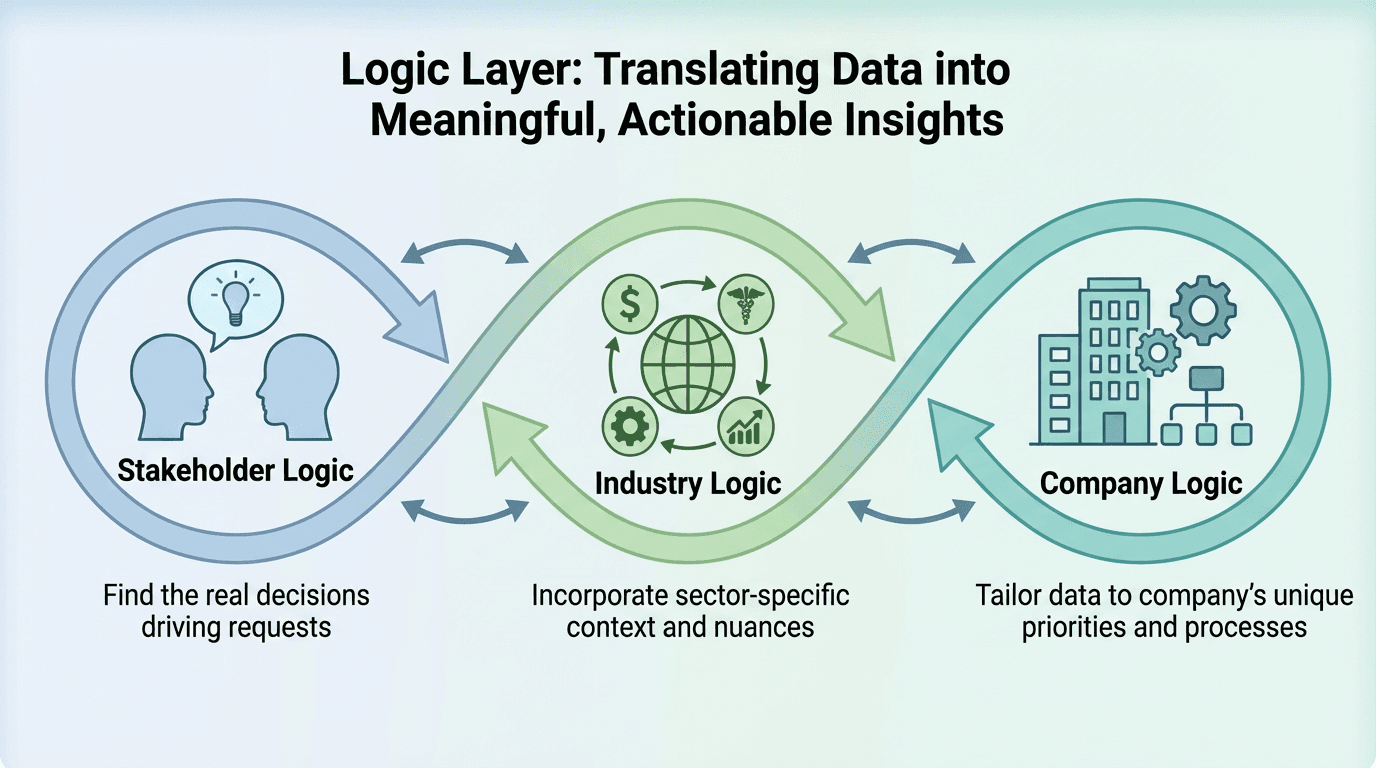
This logic can be broken into three distinct but connected areas: stakeholder logic, industry logic, and company logic.
Stakeholder logic begins with understanding what people actually need to know, not what they ask for, but what drives their decisions. In many cases, the initial request is only a surface-level expression of a deeper problem. A coach may ask for a report, an executive may ask for a dashboard, or a department may request a specific metric. If the system is simply built to that request, it is often solving the wrong problem. The real work lies in identifying what sits underneath the ask. What decision is being made? What information would actually change that decision? Is there a way to present that information more effectively than what was originally requested? In many cases, the most valuable systems are not the ones that deliver exactly what was asked for, but the ones that deliver what was actually needed, often in a form the stakeholder did not initially consider.
Industry logic adds another layer of context. Not all data behaves the same way across industries, and not all metrics carry the same meaning. What matters in one environment may be irrelevant in another. The way performance is measured in sports is fundamentally different from how it is measured in finance or healthcare, and even within the same category of data, interpretation can change based on the environment. Applying industry logic means understanding these nuances and embedding them into the system. It allows the data to be shaped in a way that aligns with how the industry actually operates, rather than forcing a generic structure onto it. This not only improves clarity but also reduces friction for the people using the system, because the outputs reflect the way they already think and operate.
Company logic is where everything becomes specific. Every organization has its own way of operating, with its own priorities, processes, and definitions. Two organizations in the same industry can interpret the same data in completely different ways based on how they are structured and what they value. A strong data system adapts to that reality. It incorporates company-specific logic into the transformation process, the modeling layer, and the way data is presented. It aligns with how the organization actually functions rather than forcing the organization to adapt to the system. This is where many implementations fail. They introduce a technically correct system that does not match how the company operates, and as a result, adoption breaks down.
When these three layers are clearly defined and consistently applied, the entire system changes. Data becomes easier to work with because it is aligned with reality. Models become more intuitive because they reflect how the business operates. Outputs become more actionable because they are tied directly to decisions. Without this layer, even the best technical systems fall short. They produce information but not insight. They generate reports but not clarity, and over time they create more questions than answers.
Building a strong logic layer requires more than technical ability. It requires leadership, communication, and the capacity to understand multiple perspectives at once. It requires knowing how to extract real needs from stakeholders, how to interpret industry context, and how to align everything with the way a specific organization operates. When combined with the technical ability to execute, maintain, and scale the system, this is what separates functional data work from impactful data work. The goal is not to move data more efficiently. It is to make better decisions, and that only happens when the logic behind the system is as strong as the system itself.
DANNY DAVIS · Executive insights