The Translation Framework
You can build a complete data system. You can connect every source, design a clean model, apply strong governance, and layer in well-defined logic. On paper, everything works exactly as it should. However, none of that guarantees value. If the person responsible for making decisions cannot look at the system, understand it immediately, and act on it with confidence, the system has failed regardless of how technically sound it is.
This is where most data efforts break down. The failure does not occur in the engineering or in the modeling. It occurs in the translation. There is a natural gap between how data systems are built and how decisions are made. Data systems are structured, precise, and layered, designed to handle complexity. Executives, on the other hand, operate in environments where time is limited, pressure is high, and clarity is non-negotiable. They are not thinking in terms of joins, schemas, or transformation logic. They are thinking in terms of outcomes: what is happening, why it is happening, and what needs to change. If a system cannot answer those questions in a way that is immediate and intuitive, it creates friction instead of value, and friction is what kills adoption.
The mistake most teams make is assuming that once the data is accurate and the dashboard is built, the job is done. They focus on delivering information rather than enabling understanding. They build visuals, metrics, and reports, but they stop short of ensuring that those outputs align with how the stakeholder actually processes information and makes decisions. Translation is what closes that gap.
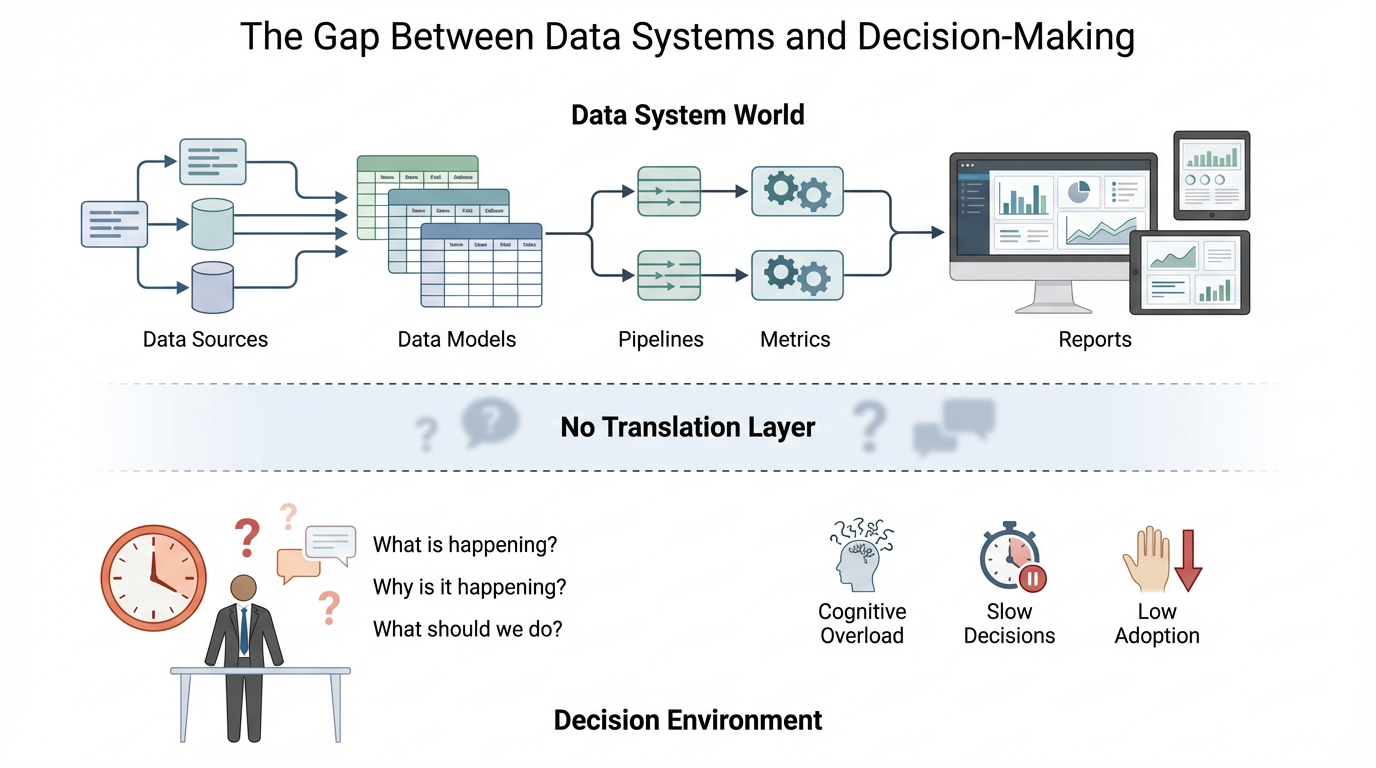
It starts by going deeper than the request. When a stakeholder asks for a dashboard or a report, that request is rarely the true need. It is a starting point, and the real work lies in understanding what they are trying to accomplish. What decision are they making? What pressure are they under? What would make that decision easier, faster, or more confident? That level of understanding cannot be achieved through surface-level interaction. It requires working directly with the stakeholder, asking the right questions, and, more importantly, interpreting the answers correctly, because often what is said and what is needed are not the same.
From there, the system has to adapt to the way the stakeholder thinks. This is where user experience becomes just as important as data accuracy. How does the individual prefer to interact with information? What level of detail do they need? What format allows them to process information quickly without having to interpret or translate it themselves? This is not about making something look clean. It is about removing cognitive load. The best systems do not require the user to think harder; they make thinking easier.
At the same time, this is where technical expertise creates leverage. A non-technical stakeholder may describe what they want in broad or incomplete terms because they do not have the language to define what is possible. The role of the system builder is not just to deliver what was asked for, but to elevate it. That means taking the request, interpreting it through a technical lens, and returning something better, something that solves the problem more effectively than the original request ever could. At this stage, translation becomes more than communication. It becomes design.
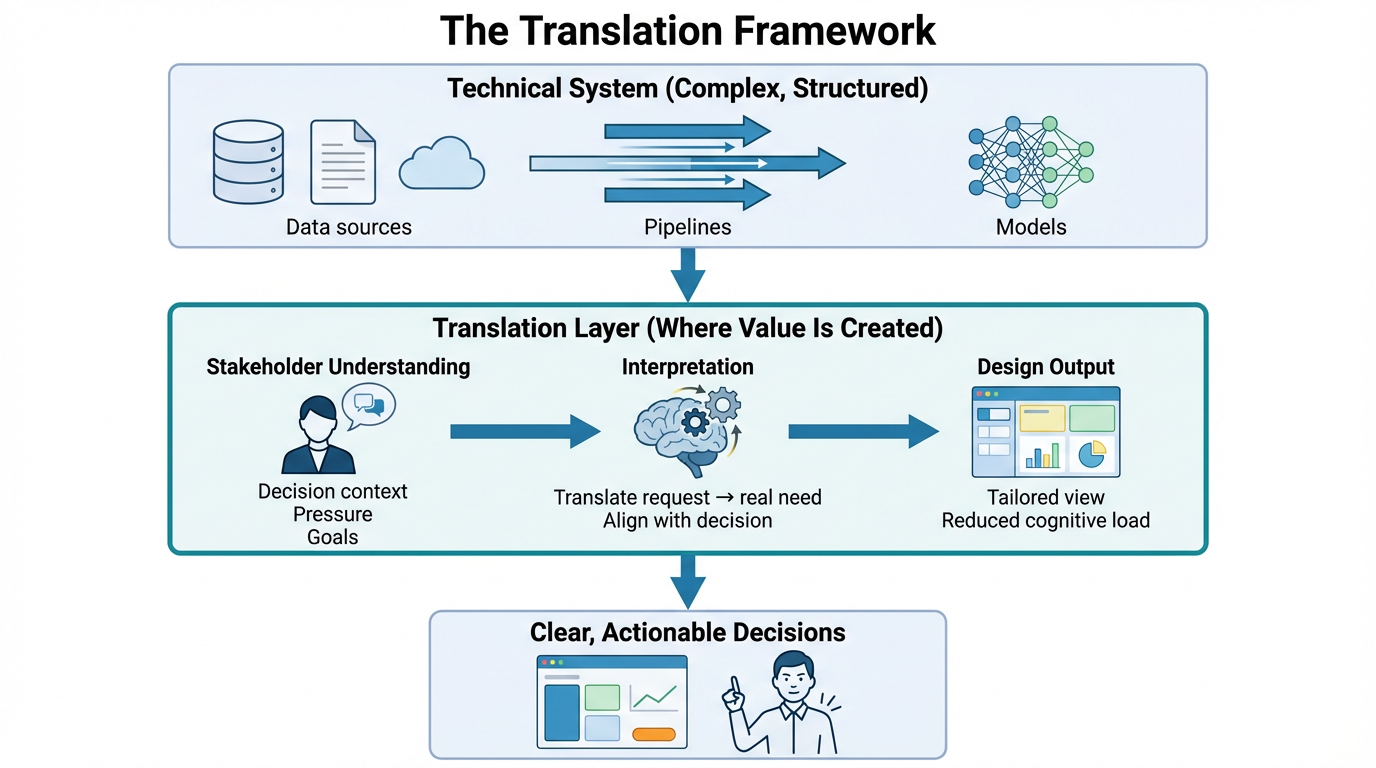
The end result is not a generic dashboard or a collection of visuals. It is a system that presents information in a way that is tailored to a specific individual or group, aligned with how they operate, and structured in a way that can scale. It is not ad hoc, reactive, or accidental. It is intentional. In practice, this is the difference between a system that is used and a system that is ignored. Many organizations have access to data and many have dashboards, but very few have systems that consistently drive decisions. The difference is not the data itself; it is how that data is translated into something actionable.
When translation is done correctly, the conversation changes. Stakeholders stop asking for new reports and start asking better questions. They spend less time interpreting and more time deciding. The system becomes something they rely on rather than something they check. Without this layer, even the most advanced data systems fall short. They deliver information, but they do not deliver clarity, and without clarity, there is no action.
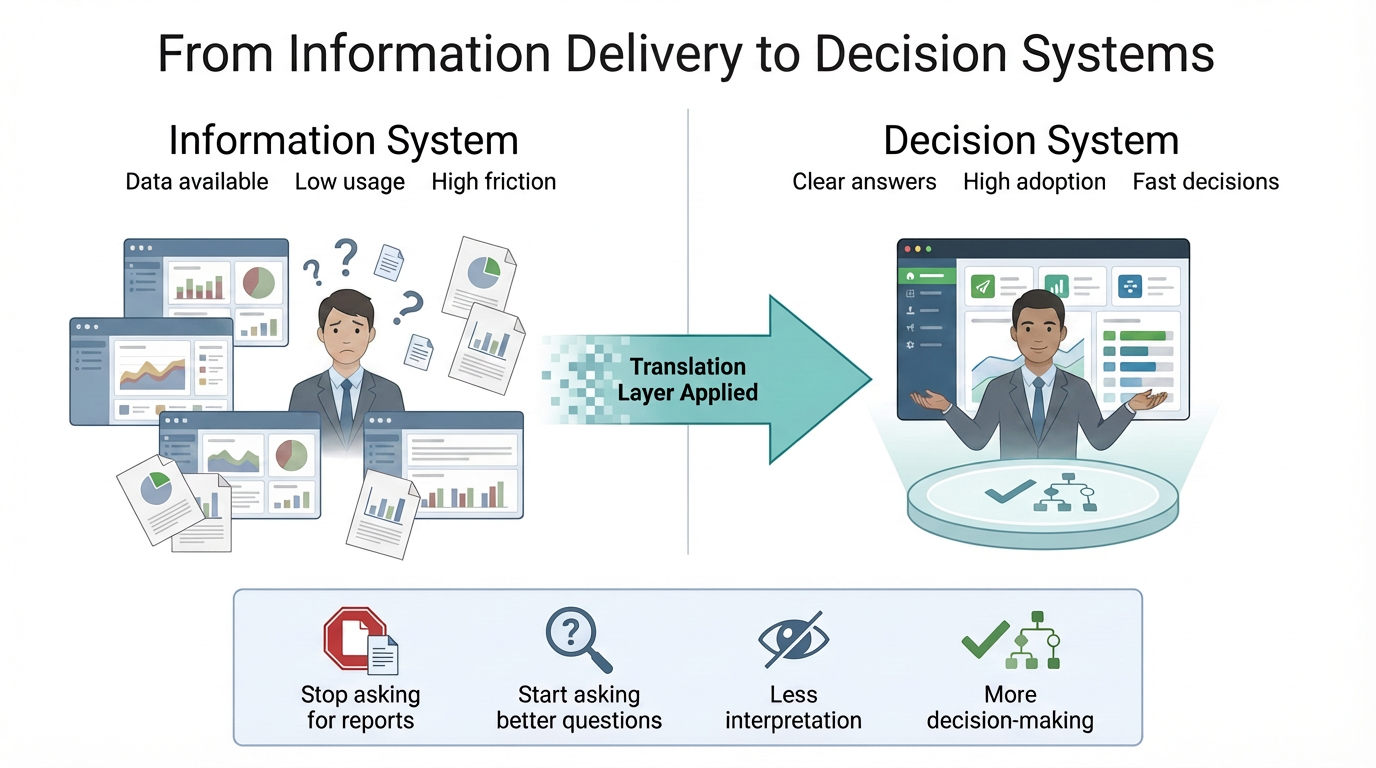
At the end of the day, the goal is not to build a system that displays data. It is to build a system that drives decisions, and that only happens when the gap between technical complexity and human understanding is fully closed.
DANNY DAVIS · Executive insights